How Breast Milk Transfers Secretory IgA for Gut Health
by Mary Ferrari
“SIgA is specifically designed to protect mucosal surfaces, including the gastrointestinal and respiratory tracts, where infants first encounter bacteria, viruses, toxins, and food antigens.”
Selective IgA Deficiency (SIgAD) is the most common primary immunodeficiency. It is characterized by very low or undetectable levels of Immunoglobulin A (IgA) in the blood and mucosal secretions.
Although many individuals with SIgAD have no symptoms, others experience:
- Recurrent Infections: Susceptibility to sinus infections, bronchitis, pneumonia, and ear infections.
- Autoimmune Diseases: A higher prevalence of autoimmune disorders, most notably celiac disease, rheumatoid arthritis, and lupus.
Allergies and Asthma: Increased rates of allergic rhinitis, eczema, and food allergies.
These observations highlight the critical role that IgA plays in maintaining healthy mucosal immunity throughout the body making SIgA transfer crucial.
In mammals, mothers provide passive immune protection by delivering Secretory Immunoglobulin A (SIgA) through colostrum and breast milk. Unlike antibodies that circulate in the bloodstream, SIgA is specifically designed to protect mucosal surfaces, including the gastrointestinal and respiratory tracts, where infants first encounter bacteria, viruses, toxins, and food antigens.
The production and transfer of SIgA is a highly coordinated biological process. As the mother’s immune system encounters microorganisms in her environment, specialized immune cells within the intestinal and other mucosal tissues become activated. These cells migrate to the mammary glands, where they produce dimeric IgA, a form consisting of two IgA molecules joined together. The dimeric IgA then binds to the Polymeric Immunoglobulin Receptor (pIgR) located on mammary epithelial cells. The receptor transports the antibody across the cell and into breast milk through a process known as transcytosis.
During this journey, part of the receptor remains attached to the antibody, forming the Secretory Component. This additional protein transforms IgA into Secretory IgA (SIgA), protecting it from degradation by stomach acid and digestive enzymes after it is consumed by the infant. As a result, SIgA survives passage through the digestive tract and reaches the intestine largely intact, where it can perform its protective functions.
Rather than killing microorganisms directly, SIgA works by coating bacteria, viruses, and toxins, preventing them from attaching to the intestinal lining. This process, known as immune exclusion, allows potentially harmful microbes to be removed naturally while minimizing unnecessary inflammation. At the same time, SIgA helps guide the development of a healthy gut microbiome by promoting beneficial bacteria and limiting the overgrowth of potentially harmful species. Through these combined actions, maternal SIgA provides newborns with a sophisticated form of immune protection while their own immune system gradually matures.
One of the most promising discoveries in recent years is the recognition that the gut microbiome itself plays an important role in regulating SIgA production. Rather than acting independently, beneficial bacteria continuously communicate with immune cells located within the intestinal wall. Their metabolic byproducts, particularly short-chain fatty acids such as acetate, stimulate immune signaling pathways that encourage B cells to mature into plasma cells capable of producing IgA. This creates a positive feedback loop in which beneficial microbes help strengthen the very immune barrier that supports their survival.
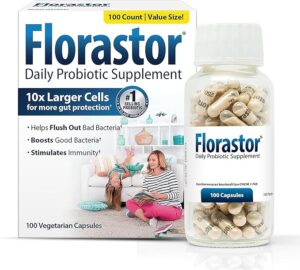
Among these beneficial organisms, Bifidobacterium longum subsp. infantis has received considerable attention because of its close relationship with human milk oligosaccharides (HMOs). During infancy, HMOs selectively nourish B. infantis, allowing it to dominate the intestinal microbiome while supporting healthy immune development. Researchers now believe that many of these same biological pathways remain active in adults, even though the mature microbiome is more stable and resistant to change.
Clinical studies have demonstrated that several commercial strains of B. infantis can increase or help maintain intestinal SIgA through different mechanisms. Some strains directly increase fecal SIgA concentrations, while others reduce intestinal inflammation, promote regulatory T cells, improve epithelial barrier integrity, or increase production of short-chain fatty acids that indirectly stimulate IgA secretion. Although the strength of evidence varies among strains, the overall findings consistently point toward improved mucosal immune function rather than simply altering bacterial composition.
Bovine Colostrum Synbiotic
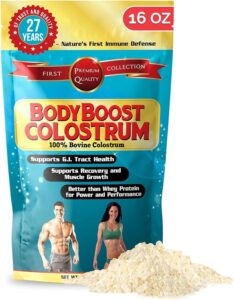
Studies have shown that the IgG in bovine colostrum functions as a natural synbiotic by providing both bioactive compounds that support the host and nutrients that favor the establishment of beneficial microbes. In two separate laboratory studies, bovine colostrum significantly modified the intestinal epithelial surface, increasing the adhesion of beneficial Bifidobacterium strains by up to 52-fold in one study and 49-fold in another, without enhancing the attachment of intestinal pathogens. The researchers found that colostrum components, particularly immunoglobulin G (IgG), altered the intestinal cell surface to create more favorable binding sites for commensal bacteria. When combined with evidence that several commercial B. infantis strains can increase or maintain intestinal secretory IgA (SIgA), reduce intestinal inflammation, and strengthen the mucosal barrier, these findings suggest that bovine colostrum and targeted probiotics may work synergistically to promote beneficial bacterial colonization, support mucosal immunity, and improve long-term gut health.
Bovine colostrum contains Immunoglobulin A (IgA), including its highly active mucosal form, Secretory IgA (sIgA).
In human breast milk and human colostrum, IgA is the primary, most abundant antibody. However, in bovine colostrum, the distribution is reversed:
Immunoglobulin G (IgG) is the dominant antibody, making up 85% to 95% of the total immunoglobulins. Immunoglobulin M (IgM) is the second most common.
Immunoglobulin A (IgA) accounts for a smaller fraction, typically ranging from 3.2 to 6.2 g/L in raw colostrum.
Even though IgA is a minor component in bovine colostrum, clinical research shows that consuming it has a powerful effect on human mucosal immunity:
Direct Mucosal Defense: The IgA and sIgA found in colostrum act as a “first line of defense”. They physically bind to, encase, and neutralize pathogens (like viruses and bad bacteria) along your digestive tract lining before they can breach the gut barrier.
Boosts Your Own IgA Production: Interestingly, studies published on PubMed show that taking bovine colostrum doesn’t just supply external antibodies, it triggers your body to produce more of its own. For example, distance runners and athletes who supplement with bovine colostrum routinely show up to a 79% increase in their own salivary sIgA levels, protecting them from upper respiratory infections during heavy training.
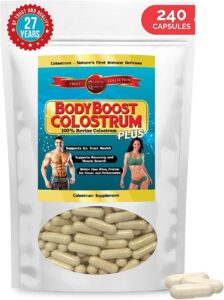
This includes commercial bovine colostrum supplements (such as powders and capsules).
Commercial colostrum powders retain their native antibody profile. Reputable companies focus heavily on marketing Immunoglobulin G (IgG) (which naturally makes up the largest percentage), they often standardize labels to show minimum IgG levels (usually between 20% to 40% IgG). Even if it is not explicitly listed on the nutrition facts, IgA and IgM are still naturally present in the powder alongside the IgG.
Immunoglobulins are delicate proteins. To turn liquid colostrum into a shelf-stable supplement powder, manufacturers must pasteurize and dry it.
High-quality supplements use low-temperature, flash pasteurization and indirect heat drying to keep the IgA and IgG fully intact and bioactive. Low-quality supplements that use excessive heat during the drying process can denature (destroy) these fragile antibodies, rendering the IgA useless.
The most notable finding from supplement trials is that taking colostrum powder orally doesn’t just passively hand you bovine IgA. Clinical trials using commercial colostrum powders, such as those published in the Journal of Applied Physiology, demonstrated that athletes taking everyday colostrum supplements experienced a significant boost in their own human salivary IgA production, which strongly protected them against getting sick.
Clinical and preclinical data.....
Out of the 7 commercial strains listed, all 7 strains contribute to increasing or maintaining secretory IgA (SIgA), but they do so through different mechanisms depending on whether they are infant-specific, adult-specific, or multi-strain therapeutic blends.
Clinical and preclinical data show varying levels of direct evidence for each strain:
Strains with Direct, Explicit Evidence for Increasing SIgA
These strains have published study data measuring a distinct, quantifiable rise in fecal or mucosal SIgA levels:
- B. infantis CECT 7210 (IM-1®): Excellent direct evidence. Pediatric clinical research published in Nature’s Pediatric Research demonstrated a direct correlation between higher levels of this strain in infant feces and significantly increased concentrations of secretory IgA. [1]
- B. infantis M-16V: Strong direct evidence. Clinical trials and maternal-infant model studies highlight that supplementation with M-16V significantly elevates fecal SIgA at weaning, enhancing mucosal barrier defense. [2, 3]
- B. infantis DSM 24737: High-potency therapeutic evidence. As part of the highly studied multi-strain formulation found in Visbiome and VSL#3, it is clinically proven to drastically boost intestinal SIgA secretion to shield against pathogen translocation and inflammatory bowel flares. [4]
Strains with Indirect or Systemic Immune-Modulating Evidence
These strains primarily function by shifting the gut environment, which indirectly optimizes SIgA production by stimulating B-cells and managing overall intestinal inflammation:
- B. infantis EVC001: Rather than just pushing SIgA numbers upward, studies show EVC001 focuses heavily on silencing gut inflammation (reducing pro-inflammatory cytokines like TNF-α and IL-1β). By restructuring the infant gut, it creates a stable ecosystem where the body’s natural, breastmilk-derived SIgA can function effectively without being degraded by inflammation. [5, 6, 7]
- B. infantis 35624: The benchmark adult strain focuses heavily on upregulating anti-inflammatory cytokines (like IL-10) and inducing regulatory T-cells (Tregs). It works synergistically with prebiotic fibers to support the body’s mucosal barrier health and baseline SIgA exclusion pathways. [8, 9]
- B. infantis BI-26 & Rosell-33: These structural strains function through competitive exclusion. By actively generating short-chain fatty acids (SCFAs), they lower gut pH, which naturally stimulates plasma cells in the lamina propria to keep SIgA production active. [10]
Source:
2023
Secretory IgA’s complex roles in immunity and mucosal homeostasis in the gut
2018
Bifidobacterium infantis Benefits for Toddler Gut & Immunity – A 12-week Clinical Study
2002
IGF-I, IgA, and IgG responses to bovine colostrum supplementation during training
Clinical and preclinical data…..
[2] https://pubmed.ncbi.nlm.nih.gov
[4] https://pubmed.ncbi.nlm.nih.gov
[5] https://pmc.ncbi.nlm.nih.gov
[7] https://www.tandfonline.com
[8] https://pmc.ncbi.nlm.nih.gov