HMO's Plus Breakthrough for Formula and Functional Milk
by Mary Ferrari
“Because these reactions occur directly in whole milk, the process could theoretically enrich ordinary milk or infant formula with a broader spectrum of authentic HMOs without requiring separate industrial fermentation for every individual oligosaccharide.”
A new process has been developed that is beyond producing common commercial HMOs and demonstrates an enzymatic platform capable of creating additional, more complex human milk oligosaccharides directly in cow’s milk. The researchers were motivated by the fact that human milk contains approximately 5–15 g/L of HMOs representing roughly 180 known structures, whereas cow’s milk contains only trace amounts, particularly of fucosylated HMOs. Current infant formulas typically contain only one or two synthesized HMOs, most commonly 2′-fucosyllactose (2′-FL) and lacto-N-neotetraose (LNnT), despite the remarkable diversity found in breast milk. Some infant formulas now contain 5 HMO’s but still not close to the 180 known HMO structures.
To address this limitation, the researchers developed a one-pot enzymatic process that combines two engineered enzymes working simultaneously at refrigeration temperature (5°C). An engineered Trypanosoma rangeli trans-sialidase (Tr15) transfers sialic acid from casein glycomacropeptide (CGMP) onto lactose and LNnT, while a Tannerella forsythia α-L-fucosidase (TfFuc1) transfers fucose from commercially available 2′-FL onto LNnT. Because these reactions occur directly in whole milk, the process could theoretically enrich ordinary milk or infant formula with a broader spectrum of authentic HMOs without requiring separate industrial fermentation for every individual oligosaccharide.
5°C is the temperature at which milk is stored and processed commercially so the engineering process cleverly fits into existing dairy manufacturing rather than requiring an entirely new production system.
The significance of the work lies in the diversity of molecules produced. Commercially available HMOs such as 2′-FL and LNnT were used as starting substrates, but the enzymes generated several additional HMOs naturally found in human milk. TfFuc1 converted LNnT into two distinct fucosylated structures: LNFP III (Lacto-N-fucopentaose III) and 2”’-FLNnT (2”’-fucosyl-lacto-N-neotetraose). At the same time, Tr15 converted lactose into 3′-sialyllactose (3′-SL) and converted LNnT into 3”’-SLNnT (3”’-sialyl-lacto-N-neotetraose). Nuclear magnetic resonance (NMR) and LC-MS analyses confirmed that these products were structurally identical to naturally occurring human milk oligosaccharides.
The enzymatic reactions proved highly efficient under practical conditions. TfFuc1 reached its highest transfucosylation yield after approximately one hour, producing about a 14% yield of the fucosylated LNnT products before hydrolysis gradually reduced concentrations. The engineered Tr15 enzyme behaved differently because its hydrolytic activity had been deliberately minimized. As a result, production of the sialylated HMOs continued increasing throughout the six-hour reaction period instead of declining. The study also demonstrated that Tr15 preferentially sialylated lactose to produce 3′-SL, although it was also capable of modifying LNnT into the more complex 3”’-SLNnT. Importantly, both enzymes functioned simultaneously without interfering with one another, allowing multiple HMOs to be synthesized in a single reaction vessel.
The final enriched milk contained six authentic HMOs: the two commercially supplied substrates, 2′-FL and LNnT, together with four newly generated HMOs—3′-SL, 2”’-FLNnT, LNFP III, and 3”’-SLNnT. This demonstrates that commercially available HMOs can serve as “building blocks” for enzymatic production of more structurally diverse oligosaccharides that more closely resemble the complexity of human breast milk. The authors conclude that this approach may represent a new manufacturing strategy for producing HMO-enriched milk beverages and next-generation infant formulas containing a wider spectrum of biologically relevant oligosaccharides than is currently available.
The commercial importance of this technology is substantial. The authors note that the global Human Milk Oligosaccharide (HMO) market is projected to grow from approximately US$200 million to US$555 million by 2027, driven by increasing demand for next-generation infant formulas and functional nutrition products. This new enzymatic approach could expand that market further by enabling the production of more complex, breast milk-like HMO mixtures for both infant and adult applications.
The global infant formula market was valued at approximately US$88 billion in 2025 and is projected to reach nearly US$97 billion in 2026, with forecasts exceeding US$200 billion by 2034.
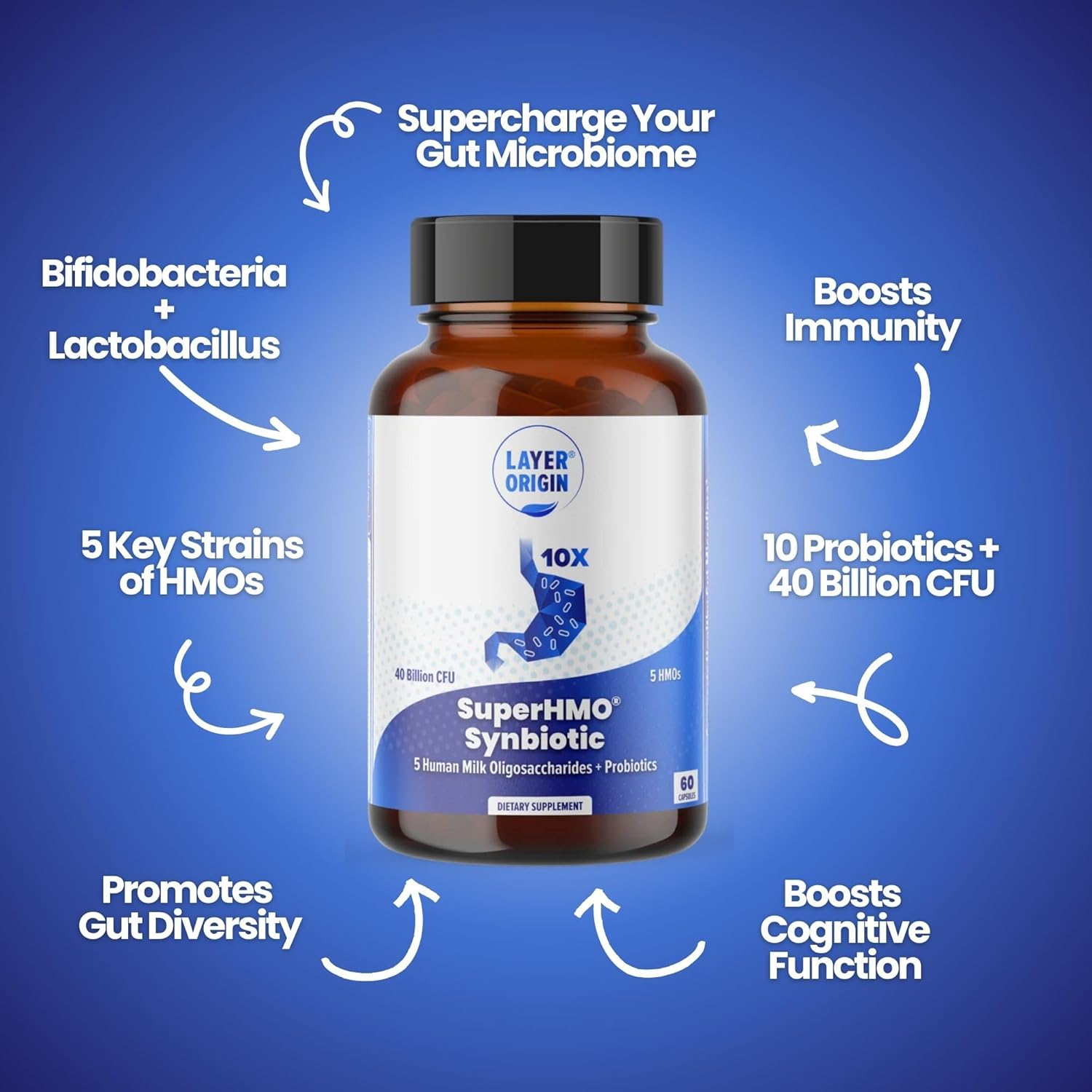
Layer Origins
"Feel better almost immediately I have dysbiosis that has led to SIBO, systemic inflammation, dermatological and joint related issues. On bad flares I get intense joint inflammation and pain to the point of feeling as if I’ve had arthritis for fifty years. Taking this product for just two or three days reverses the inflammation to where I honestly can’t even feel it and my SIBO gas is reduced significantly. This stuff does not make me feel bloated and I can barely tell it is in my shaker" J.
HMO Dairy Production
| HMO | Present in most commercial 5-HMO formulas? |
|---|---|
| 2′-Fucosyllactose (2′-FL) | ✅ Yes |
| Lacto-N-neotetraose (LNnT) | ✅ Yes |
| 3′-Sialyllactose (3′-SL) | ❌ Usually not |
| 3”’-Sialyl-lacto-N-neotetraose (3”’-SLNnT) | ❌ No |
| Lacto-N-fucopentaose III (LNFP III) | ❌ No |
| 2”’-Fucosyl-lacto-N-neotetraose (2”’-FLNnT) | ❌ No |
HMOs generated in this paper that are not included in Layer Origin’s blend:
3′-Sialyllactose (3′-SL)
3”’-SLNnT
LNFP III
2”’-FLNnT
These four represent more structurally complex, second-generation HMOs. Rather than being synthesized individually by microbial fermentation, the study demonstrates they can be produced enzymatically from existing HMOs. This suggests a potential future direction in HMO manufacturing: using a small number of commercially produced “parent” HMOs as substrates to create a much broader and more breast milk-like oligosaccharide profile. The authors do not claim this process reproduces all ~180 known HMOs, but it provides proof-of-concept that increasingly complex HMO mixtures may become feasible in future nutritional products.